

What You Can Do About Back Pain and Why Stretching Isn’t the Solution


Where things used to be carried, they are now rolled. Where there used to be muscles, there are often little more than remnants. In a few decades, well-developed glutes will probably be found alongside the appendix and the nictitating membrane in biology textbooks under the heading “Vestigial structures: features that have partly lost their function”. Well, we are not quite there yet, but as exaggerated as that may sound, it is not entirely untrue either. When the glutes no longer do their job and the hamstrings are too weak, other muscles have to take over, with the result that they become overloaded. One-sided training, poor posture and incorrect lifting obviously make the problem even worse. The good news: we have the solution!
Back Pain Is Becoming Increasingly Common
The Swiss League Against Rheumatism published its Back Report 2020, comparing surveys from 2011 and 2020. The results remain concerning. In the first version of this blog post, which was written before 2020 and based on data from 2011, we already reported that 39% of respondents experienced back pain several times a week or month. By 2020, that figure had risen to 50% – and there is no sign of the trend reversing.
We see the same thing at Personalworkout. The number of people who come to us because of back pain, or at least partly because of it, has increased. The good news is that with more experience, we have become increasingly effective at treating back pain.
Acute and Chronic Back Pain
First of all, it is important to distinguish between acute and chronic back pain. Back pain is considered acute if it lasts less than 6 weeks. Chronic back pain lasts more than 12 weeks.
The most common cause of acute back pain is overload. This can develop gradually, for example as a result of prolonged poor posture, faulty movement patterns and weak muscles (more on that later), or it can occur suddenly in the form of lumbago, commonly known as a slipped back. Here too, the cause is a sudden faulty movement combined with weak muscles or poor muscle activation. Whether a blocked SI joint is the cause or the result of lumbago remains unclear. More on that, and what you can do about it, in a moment.
Wear and tear on the vertebrae, herniated discs and similar issues can also cause back pain. These tend to be more chronic in nature. What is interesting is that practically all “older” people show signs of wear and tear on an MRI scan, yet not all of them experience pain! Out of pure curiosity, I also had an MRI of my own back. On the one hand, I was surprised, but on the other, not really. Among other things, the report stated:
“Minor degenerative changes to the disc as well as a shallow disc bulge at L1/L2, with mild bone marrow oedema at the endplates in the L1/L2 region.”
What may sound concerning does not cause me any pain, either in everyday life or during strength training.
The conclusion is this: signs of wear and tear do not necessarily cause pain, and pain does not necessarily mean there is wear and tear. The whole issue is much more complex.
The Real Causes of Back Pain
Generally speaking, the stronger your “core” is, the less likely things are to shift and the better your spine is protected in everyday life. Besides the abdominal muscles, this also includes the pelvic floor and the back muscles themselves.
Contrary to this, many clients with back pain have come to us with an already strong core, including strong back muscles. How is that possible?
Either they did not know how to activate these muscles and showed faulty movement patterns, or they were unable to activate them properly at all, for example because of incorrect breathing.
Ever heard of gluteal amnesia? This issue, sometimes also called “Dead Butt Syndrome”, is a modern-day phenomenon linked to our lifestyle. We spend most of our time sitting, which means that hip extension, the movement the glutes are responsible for, is hardly performed anymore. “Dead” or “sleeping” glutes, a flat backside and overworked back muscles are the result. In technical terms, this is also known as Lower Crossed Syndrome. If the pain is more in the neck or upper back, Upper Crossed Syndrome may also be responsible. The two often occur in combination.
Poor habits when lifting things, tying your shoes, brushing your teeth or exercising make the problem even worse.
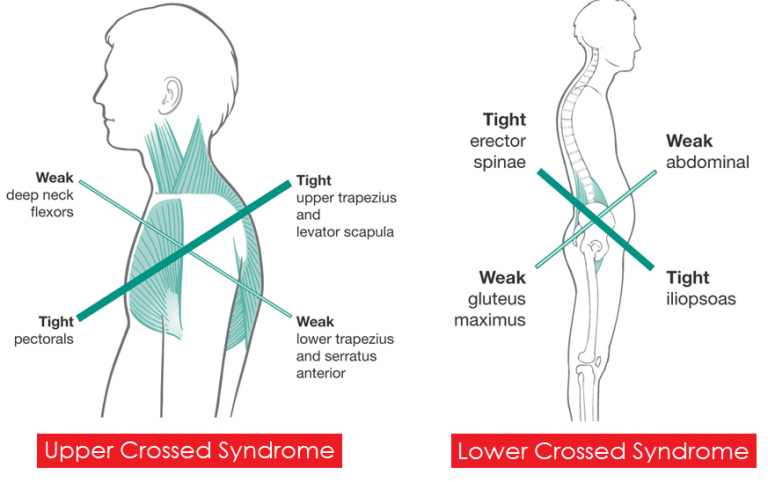
Quelle: https://yourpinnacle.com.au/blog/upper-crossed-lower-crossed-syndrome/
What You Can Do About Acute Back Pain
A blocked SI joint is by far the most common cause of back pain among our clients. It typically causes one-sided back pain that often radiates into the glutes or even the back of the thighs. Seeing a good osteopath who can release the SI joint is the most effective solution. In Zug, Personalworkout works together with I.O.M. and TZZ.. You can find out more about our partners here.
Until your appointment, heat or movement can help, often in the form of stretching exercises. But that does not mean stretching is the solution to back pain. More on that in the next section.
Movement and Strength Training as the Key to Back Pain
The goal is to wake the glutes up from their deep sleep and teach them to perform their original function again. The back extensors often become the “prime mover”, meaning that when standing up, people think about lifting themselves with their back. But standing up is the job of the glutes. There is a reason why the glutes are the largest muscle group in the body. In training terminology, their function is called hip extension. This means “extending the hip” by opening the angle at the hip joint. The upper body then straightens automatically, but as a consequence of the movement rather than its origin. Once the movement pattern is correctly reconnected to the brain and controlled again, the back can return to being the endurance athlete it was designed to be, performing a largely static role. Tension decreases and the back pain subsides. Strengthening the “core” then becomes secondary and helps ensure that everyday tasks such as carrying or lifting on one side can be performed safely. Last but not least, proper breathing and correct execution of strength exercises are essential. Time and again, we see that both have often been taught and learned incorrectly.
Why stretching can feel good for acute back pain but is not the solution is explained in detail in our blog post “Stretching, Flexibility and Mobility: Understanding the Science Behind Them”.
What Else You Can Do About Back Pain
We have already talked about good posture. On the one hand, it is about building up the muscles in the upper back, while at the same time maintaining correct posture in everyday life. This applies both when sitting and when standing. In general, we should spend much more time working while standing. In the blog post “Less Back Pain Thanks to a Standing Desk”, you can find out how to make the switch without any problems.
Another often overlooked topic is sleep. While you sleep, your back and neck muscles should be able to relax. That only works if they are properly supported. A good mattress, a good bed base and a good pillow are essential. The maximum lifespan of a bed is around 10 years, and getting advice from a good specialist store is indispensable. Before I found my current mattress, I tested two others first. At Traumwerk Ebikon, you can do this free of charge if you then buy a mattress. There are certainly other specialist stores that offer the same option.
SOURCES
- https://www.rheumaliga.ch/assets/doc/CH_Dokumente/medien/grosser-rueckenreport-2020/Rueckenreport-2020_200713_151140.pdf
- Sonntagszeitung, Rückenschmerzen, 24.3.2019
- Janda, Manuelle Muskelfunktionsdiagnostik, 5. Auflage, 2016
- Stuart McGill, Ultimate Back Fitness and Performance, 2017
- Dr. Kelly Starrett, Sitzen ist das neue Rauchen, 2016

Challenge of the Month
What Clients Say




What You Get